
Libya Heritage Guide · Roman North Africa
Leptis Magna Libya: Complete Guide to the Ancient Roman City
Leptis Magna Libya is one of the great archaeological cities of the Mediterranean world. Founded as a Phoenician trading port and transformed over centuries under Roman rule, the city reached an extraordinary level of monumental development during the Severan period. Today visitors can walk among forums, arches, baths, a theatre, market, basilica, harbour structures and the remains of everyday urban life — all within one vast archaeological landscape near the modern city of Khoms.
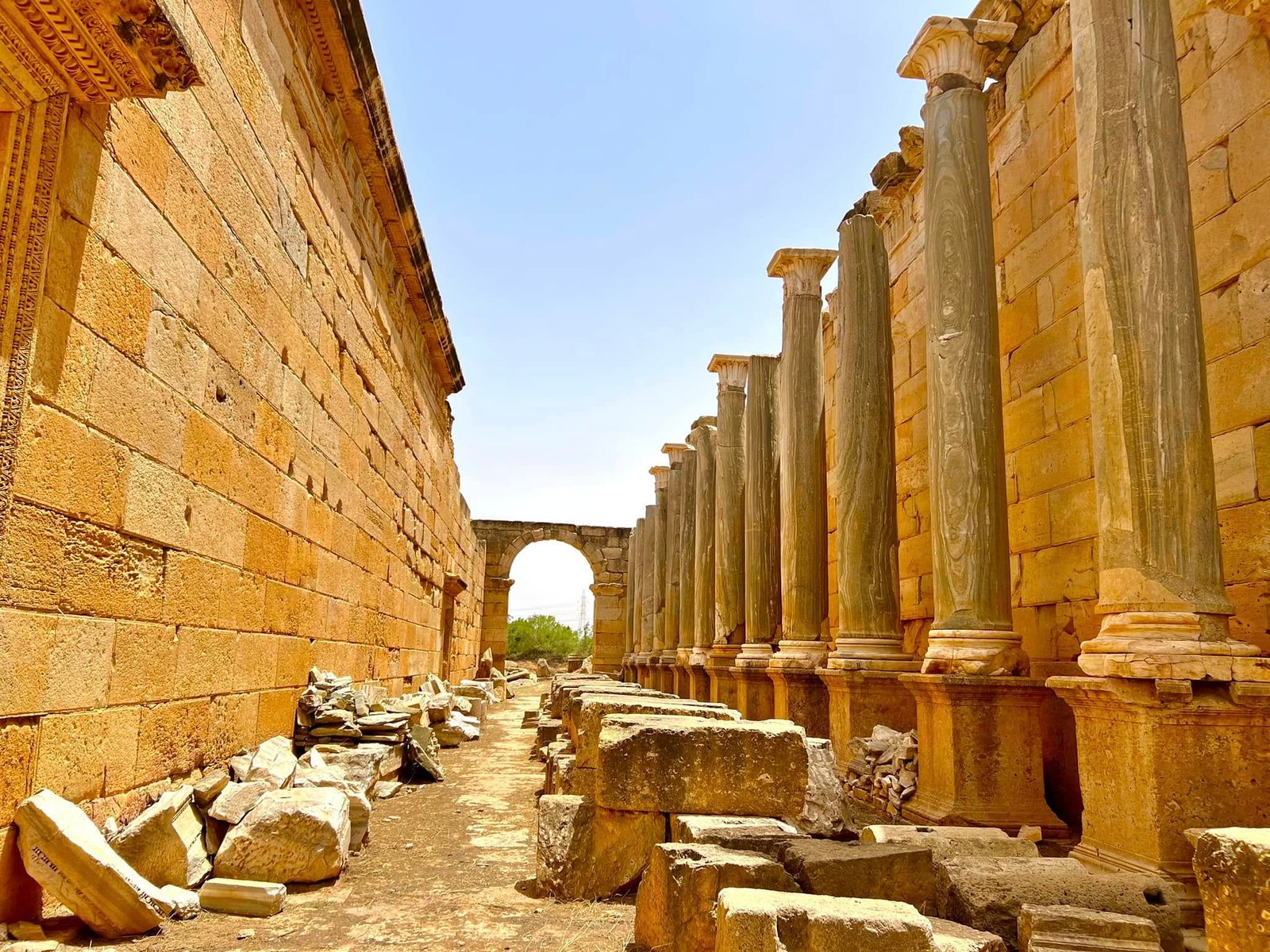
Why Leptis Magna is one of Libya’s greatest archaeological sites
The first impression of Leptis Magna Libya is scale. This was not a small settlement centered around one temple or theatre. It became a major city whose civic, commercial and ceremonial buildings spread across a broad coastal landscape. The surviving remains allow visitors to follow ancient streets and move between spaces that once served very different purposes.
The story begins before Rome. Leptis Magna developed from a Phoenician trading port established on the North African coast. Its position near the mouth of Wadi Lebda gave the settlement access to the Mediterranean and helped connect maritime trade with agricultural production and routes extending inland.
Roman expansion changed the scale and appearance of the city. Monumental construction increased over time, but the transformation associated with the Severan dynasty was especially important. Emperor Septimius Severus had been born at Leptis Magna, and his reign brought the city a level of imperial attention that can still be read in its architecture.
For visitors today, the result is unusually satisfying. A city that once depended on trade, civic ceremony, public entertainment and administration can still be explored on foot. The ruins communicate not only wealth but also organization: streets lead toward public spaces, shops face areas of movement, baths occupy an important social position, and monumental architecture marks civic identity.
UNESCO describes Leptis Magna as offering a particularly vivid picture of life in a Roman provincial city. That description captures what makes the site so rewarding. You do not need to be an archaeologist to understand that you are moving through the remains of a real city, built for thousands of people rather than for a single ceremonial purpose.
Historical Timeline
From Phoenician trading port to Roman imperial city
Leptis Magna developed through several historical layers. Its architecture reflects that long story rather than a single moment in time.
Phoenician beginnings
UNESCO identifies the origins of Leptis Magna with a Phoenician trading port established in the seventh century BCE. The coastal location offered access to Mediterranean exchange while nearby hinterland routes connected the settlement with local production and inland commerce.
A growing North African city
Integration into the Roman world brought new political status, economic connections and architecture. Earlier parts of the city remained important while new streets, public spaces and monuments gradually changed the urban landscape.
The Severan transformation
Leptis Magna reached one of its most impressive periods of monumental development under the Severan emperors. Septimius Severus, born in the city and emperor from 193 to 211 CE, became central to this transformation.
Changing fortunes and preservation
Like many ancient Mediterranean cities, Leptis Magna experienced changing economic and political conditions over later centuries. Wind-blown sand eventually covered and protected significant parts of the archaeological landscape, contributing to the remarkable state of preservation visible today.
Location
Where is Leptis Magna in Libya?
Leptis Magna lies in the District of Khoms on Libya’s Mediterranean coast, east of Tripoli. Its location beside Wadi Lebda and the sea helps explain the importance of its ancient harbour and its long connection with trade.
Imagine the Ancient City
Leptis Magna 1,800 years ago
Around eighteen centuries ago, Leptis Magna would have presented a completely different image from the quiet archaeological landscape visitors see today. Streets were active with residents, traders, officials, craftsmen, visitors and workers moving between markets, public buildings and residential districts.
Marble and decorated stone gave important civic areas a monumental appearance. Columns framed public spaces. Shops opened toward areas of pedestrian movement. The theatre and other entertainment buildings drew crowds, while public baths functioned as social spaces as well as places for bathing.
The harbour connected this urban life with the Mediterranean. Goods moved through warehouses and commercial areas, while agricultural products from the surrounding region entered wider trade networks. Leptis Magna was not isolated at the edge of the Roman world. It was connected to it economically, politically and culturally.
The city’s prosperity also expressed itself through architecture. Monumental construction made statements about civic identity and imperial power. Under the Severans, that relationship became particularly visible as new public spaces transformed the city on a scale worthy of an important Roman center.
Thinking about Leptis Magna this way changes the experience of visiting the ruins. A column is no longer only a surviving stone object. It was once part of a street, portico, temple, forum or civic building used by people moving through a living city.
The Emperor from Leptis Magna
Septimius Severus and the city’s monumental transformation
Septimius Severus occupies a special place in the history of Leptis Magna Libya. Born in the city, he later became Roman emperor and ruled from 193 to 211 CE. His connection with Leptis gave the city an unusual relationship with imperial power.
During the Severan period, Leptis Magna was enlarged and embellished on an extraordinary scale. Major architectural projects changed both the appearance and ceremonial organization of the city. These projects were not simply practical construction. They presented Leptis Magna as a city capable of standing alongside important centers elsewhere in the Roman world.
The Severan Forum is one of the clearest expressions of that ambition. It created a vast monumental environment in which architecture, decoration and civic identity worked together. Nearby, the Severan Basilica added another major public building, while the monumental arch associated with Septimius Severus announced imperial presence within the street network.
UNESCO specifically highlights the Severan Forum, basilica and arch among the outstanding monuments of the Roman world. Their artistic character also reflects influences beyond Rome itself, including African and eastern traditions.
This mixture is important because Leptis Magna should not be imagined as a simple copy of an Italian Roman city. It was a North African city with its own earlier history, its own trading environment and its own cultural connections. Roman rule transformed it, but the surviving art and architecture reveal a more complex Mediterranean identity.
Ancient City Atlas
What to see at Leptis Magna
The site contains far more than one famous building. Its strength comes from the number and variety of surviving monuments and the way they fit together into a recognizable ancient city.
Arch of Septimius Severus
The monumental arch is one of the most recognizable landmarks of Leptis Magna. Its scale and decorative program reflect the city’s close relationship with the Severan dynasty and the importance of imperial imagery in the urban landscape.
Severan Forum
The Severan Forum represents one of the greatest statements of civic architecture at the site. Walking across its open space helps visitors understand the ceremonial scale achieved during the city’s major imperial rebuilding phase.
Severan Basilica
The basilica belongs to the monumental Severan complex and is notable for its scale, architectural organization and decorative stonework. It demonstrates how public architecture communicated authority and urban prestige.
Public Baths
Roman baths were much more than practical washing facilities. They functioned as important social environments where architecture, leisure and daily routine came together.
Theatre
The theatre reminds visitors that entertainment was built into the urban fabric. Its surviving seating and architectural organization still make the relationship between performance and audience easy to imagine.
Market
The market is particularly important because it moves the story away from emperors and monuments toward daily commerce. Colonnades, shops and associated structures illustrate how ordinary economic activity fitted into the city.
Amphitheatre & Circus
Large entertainment structures demonstrate both the population and the social investment required to organize public spectacles. They add another layer to the picture of urban life at Leptis Magna.
Ancient Harbour
The harbour is one of the most important engineering features of the city. UNESCO highlights its artificial basin, water-control works and surviving infrastructure as evidence of sophisticated Roman engineering.
Old Forum & Temples
Earlier civic spaces remind visitors that Leptis Magna did not suddenly appear during the Severan age. The city developed gradually, and older areas continued to exist alongside later monumental additions.
Beyond the Imperial Monuments
What daily life looked like in a Roman North African city
The most famous monuments naturally attract attention, but the quieter parts of Leptis Magna are just as important for understanding the city. UNESCO emphasizes that the site preserves evidence not only of great public architecture but also of the ordinary systems that made urban life possible.
Markets and shops show how goods were sold. Warehouses point toward storage and commercial activity. Workshops reveal production. Streets organize movement between civic, religious, residential and commercial areas.
A resident of ancient Leptis Magna would have known the city through routine rather than archaeology. The market might have been associated with work or purchasing food. The baths could provide social time. Religious buildings structured public and private devotion. The theatre and amphitheatre offered entertainment and spectacle.
The harbour tied these everyday experiences to a much wider world. Ships, goods, officials and travelers linked the city with Mediterranean networks, while the surrounding agricultural landscape supported local and regional commerce.
This is one reason Leptis Magna is so powerful for modern visitors: monumental architecture and ordinary life survive in the same archaeological landscape.
Watch Leptis Magna
See the ancient city in motion
Photographs show individual monuments, but video is especially useful for understanding distance and scale. These two selected videos give another perspective on the archaeological landscape of Leptis Magna.
Why Leptis Magna has global heritage importance
UNESCO’s recognition helps explain why Leptis Magna matters beyond Libya. The site preserves a combination of architecture, engineering, artistic decoration and urban organization that makes it an unusually complete archaeological record.
The Severan monuments are especially important. UNESCO places the forum, basilica and monumental arch among the finest surviving monuments of the Roman world and notes the African and eastern influences visible in their artistic character.
The ancient harbour is equally significant. Its surviving basin, associated structures and engineering works demonstrate how much technical planning was required to support a large commercial city on the Mediterranean coast.
The market adds another dimension. UNESCO emphasizes the survival of shops, colonnades and commercial infrastructure because heritage value is not limited to imperial architecture. Evidence of ordinary economic life is part of what makes the site so complete.
Wind-blown sand played an important role in preservation by covering much of the ancient city for centuries. Modern excavation revealed a remarkable amount of surviving urban fabric, allowing Leptis Magna to retain a level of authenticity that continues to impress visitors and researchers.
Two Great Roman Sites
Leptis Magna or Sabratha — should you visit both?
Leptis Magna and Sabratha are often mentioned together because both are major ancient sites in western Libya, but the experiences are different enough that one should not replace the other.
Leptis Magna
Leptis Magna impresses through scale, complexity and the completeness of the ancient urban environment. The forums, baths, market, basilica, theatre, entertainment structures, streets and harbour create the sense of exploring an entire Roman city.
It is especially strong for travelers interested in Roman urbanism, Septimius Severus, engineering and monumental architecture.
Sabratha
Sabratha has a different visual identity. Its famous theatre, Mediterranean setting and mixture of Punic, Roman and early Christian layers make it one of Libya’s most atmospheric archaeological sites.
Rather than choosing between them, travelers interested in antiquity benefit from seeing how two coastal cities developed differently within the wider history of Tripolitania.
Explore our Sabratha guide →Planning Your Visit
Visiting Leptis Magna from Tripoli
Leptis Magna works particularly well as a full archaeological day from Tripoli. Because the site is large, it deserves enough time to move beyond the most famous monuments and understand how the different areas connect.
Comfortable footwear matters. Ancient paving, stone surfaces and open archaeological ground can make a long day more demanding than a museum visit. The site is also exposed, so water, sun protection and practical clothing are useful.
A guide adds significant value because the archaeological remains are extensive. Without historical context, visitors may appreciate individual buildings but miss the relationship between older parts of the city, Severan additions, commercial areas and the harbour.
Photography is rewarding throughout the site. Broad urban views help communicate scale, while architectural details reveal the quality of carving and construction. Morning and later afternoon light can also give columns and stonework stronger depth.
Most importantly, avoid treating Leptis Magna as a quick stop. The city makes sense through movement. Walking from one area to another is part of understanding how Roman urban life was organized.
Travel with Libya Adventures
Include Leptis Magna in a private Libya itinerary
Leptis Magna is one of the central heritage stops in our Roman and historical programs and can also be included in a tailor-made private itinerary.
Explore Leptis Magna as part of our Roman Archaeological – 4 Days program, Historical Libya – 9 Days journey, or a customized itinerary combining Tripoli, Sabratha and other cultural destinations.
Frequently Asked Questions
Leptis Magna Libya FAQ
Where is Leptis Magna in Libya?
Is Leptis Magna a UNESCO World Heritage Site?
Who founded Leptis Magna?
Why is Septimius Severus important to Leptis Magna?
What can you see at Leptis Magna?
Why is Leptis Magna so well preserved?
Should I visit Leptis Magna and Sabratha?
Can Libya Adventures arrange a private Leptis Magna visit?
Continue Exploring
More Libya archaeology and heritage
Explore Ancient Libya
Walk through one of the great ancient cities of North Africa
Tell us your preferred travel dates, group size and the places you want to explore. Libya Adventures can discuss a private itinerary combining Leptis Magna with Tripoli, Sabratha and other historical or cultural destinations in Libya.
Send an Enquiry →