
LIBYA ADVENTURES · BUSINESS VISITS
Libya Business Opportunities: Sectors & Market Entry Guide
Exploring Libya business opportunities starts with a practical question: who would buy your product or service, and what would it take to deliver it reliably? A promising conversation is useful. A verified customer, a workable payment route and a clear plan for the next meeting are more useful still.
This guide helps companies organise their first assessment of the Libyan market, prepare questions for potential partners and plan a focused business visit. Libya Adventures supports the travel arrangements around that visit.
Request a Business Visit Quote
1. Libya’s Market: Potential and Practical Constraints
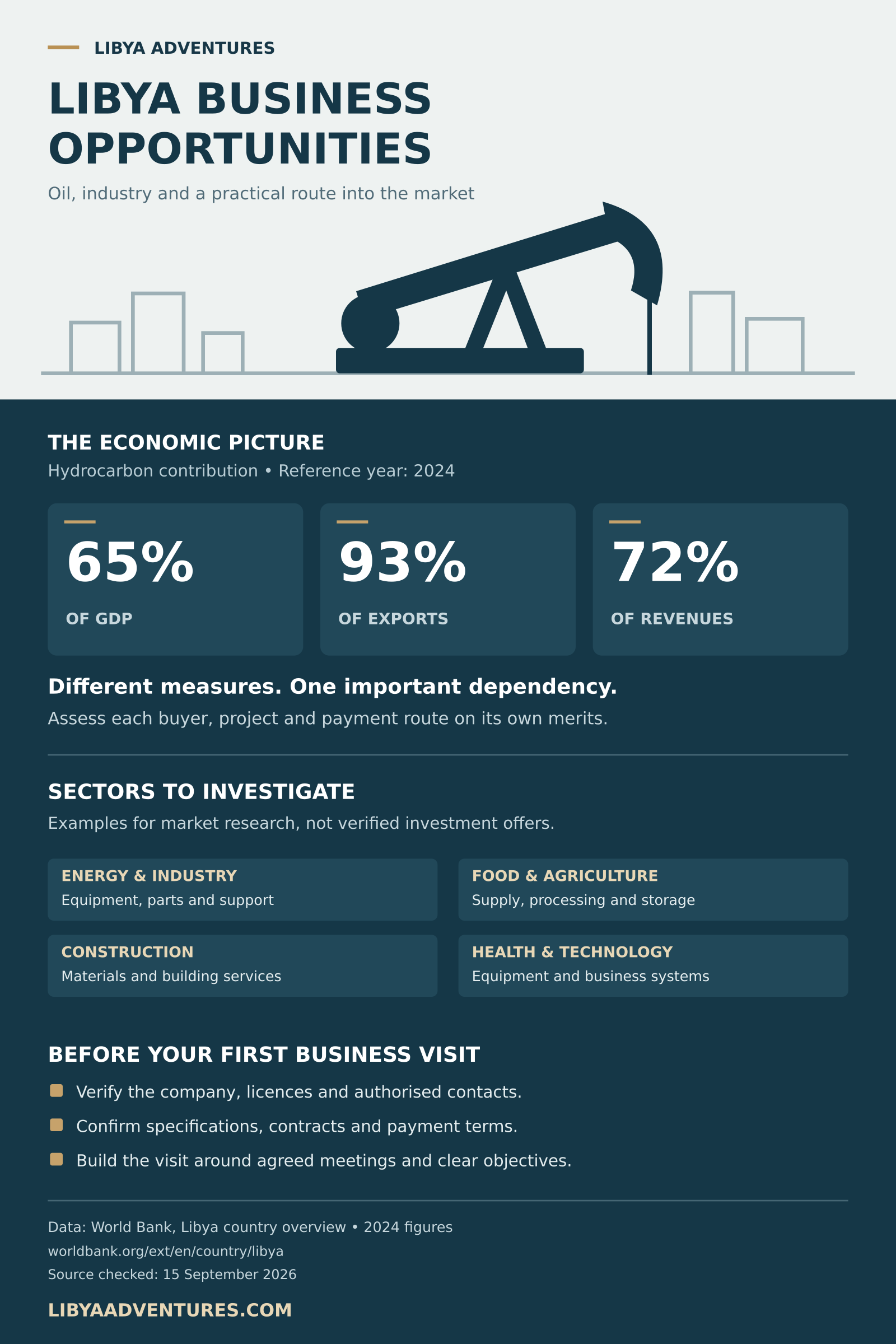
Libya’s economy is closely tied to hydrocarbons. The World Bank’s Libya overview reports that hydrocarbons represented 65% of GDP, 93% of exports and 72% of revenues in 2024. These are different measures: export dependence should not be presented as the sector’s share of the whole economy.
The same source identifies political fragmentation, weak infrastructure and constraints on private enterprise as obstacles to development. For a visiting company, the practical response is to investigate the specific customer, location and delivery chain behind an opportunity. National potential does not establish that an individual project is funded or ready to proceed.
Begin with a narrow commercial brief. A food supplier might investigate one product category and a small group of distributors. An equipment manufacturer might focus on replacement parts, maintenance requirements and the buyer’s ability to support the installed equipment. Each approach gives the first visit a question it can realistically answer.
Separate investment promotion from project approval
Libya’s General Authority for Investment Promotion and Privatization Affairs publishes information about investment incentives, investor services and the framework associated with Investment Law No. 9 of 2010. Its website also describes a one-stop investor service. This is a useful official starting point for enquiries.
Before relying on an incentive, ask the authority and a qualified local adviser whether your proposed activity, ownership structure and project meet the applicable conditions. Obtain current written guidance on registration, licences, tax treatment and any land arrangements. Do not build a budget around an exemption that has not been confirmed for your project.
2. Sectors to Investigate Before Entering the Market
The table below is a research framework, not a list of live tenders or verified investment offers. The activities are examples to investigate with prospective customers. Confirm demand, permissions and commercial viability before committing resources.
| Sector | Possible activity to explore | What to verify first |
|---|---|---|
| Food and distribution | Packaged products, wholesale supply and storage solutions. | Importer credentials, product approvals, labelling, shelf life, storage conditions and realistic order volumes. |
| Construction and building services | Materials, equipment, installation support and maintenance. | Project owner, funding, procurement authority, specifications, delivery access and who accepts completed work. |
| Energy and industrial supply | Spare parts, monitoring equipment and technical support. | Buyer qualification, vendor registration, end use, technical standards and applicable export restrictions. |
| Healthcare | Medical equipment, consumables and maintenance support. | Relevant approvals, authorised importer, servicing capacity, training and warranty responsibilities. |
| Agriculture and food processing | Irrigation components, processing equipment and packaging. | Utilities, local operating conditions, inputs, technical support and the customer’s production plan. |
| Technology and business systems | Inventory software, business applications and support services. | Customer budget, connectivity, data obligations, licensing and the ability to maintain systems locally. |
| Logistics and warehousing | Storage, handling systems and shipment coordination. | Operating permissions, customs responsibilities, routes, insurance, storage capacity and delivery records. |


Compare opportunities using the same questions: who pays, who approves, what problem is being solved, and what evidence supports the expected demand? A smaller order with clear responsibilities may be a better starting point than a large proposal with no confirmed buyer.
Keep a short record for each lead: contact name, legal company name, activity, estimated requirement, evidence received, unanswered questions and next action. This makes it easier to compare discussions after the trip, when several proposals may sound similar.
3. Check Companies, Licences, Contracts and Payment Terms
Confirm who you are dealing with
Request the counterparty’s registered name, registration details, operating address and the names of the people authorised to act for it. Compare these details with its quotation, proposed contract and bank information. Ask a qualified adviser to verify current records through the relevant channels.
Visit the premises relevant to the proposed work when practical. A warehouse visit can help you understand handling and storage; a technical meeting can clarify servicing capacity. Neither replaces documentary verification. Ask for references related to similar work and follow them up independently.
Match permissions to the proposed activity
A company’s existence does not answer every question about what it can import, distribute or perform. Identify the exact goods or services involved and ask which licences or approvals apply. Where a company claims to represent a manufacturer, request confirmation of that relationship directly from the manufacturer.
Agree who will obtain approvals and who bears the cost if a shipment or project cannot proceed. Put unresolved requirements on a written action list. Avoid allowing an urgent delivery request to become a reason to skip checks.
Make the contract specific
Have qualified counsel review the proposed arrangement. The commercial draft should identify the parties, scope, specifications, quantities, delivery location, inspection process, acceptance criteria and responsibilities for defects or delays. Include the contract language, dispute arrangements and how changes must be approved.
For distribution discussions, define the territory, sales expectations, support obligations and any proposed exclusivity. Before making a long commitment, consider how performance will be assessed and what happens if agreed targets are missed.
Agree a workable payment route
Discuss currency, payment milestones, documentation and banking arrangements with your bank before accepting a payment promise. Check the beneficiary details independently. Confirm any requested change of bank account using an established contact channel.
Sanctions also need attention. The US Treasury’s OFAC Libya programme remains active; its page lists applicable authorities and licensing information. It would be inaccurate to say that all Libya-related sanctions have disappeared. Ask your compliance adviser and bank to assess the parties, ownership, goods and payment route against the rules that apply to your transaction.
A small first order or staged engagement can give both sides a chance to demonstrate performance, where commercially appropriate. Agree the evidence needed before moving to the next stage rather than relying on verbal assurances.
4. Plan a Business Visit Around Decisions
Before choosing dates, write down what the visit must establish. You may need to assess a distributor, inspect facilities, clarify a customer’s specification or discuss a pilot order. Limit the agenda to work that benefits from being done in person.
Confirm meetings before building the itinerary
For each meeting, request the address, attendees, their roles, the agenda and expected duration. Establish whether the people present can answer technical questions or approve commercial terms. Send a short company introduction and the key questions in advance.
Group appointments sensibly and allow time between them. Keep arrival day flexible and leave space for follow-up discussions. For a trip involving several cities, confirm transport and local arrangements before treating every appointment as achievable.
Prepare two sets of documents
- Meeting materials: company profile, relevant product information, specifications, discussion points and any proposed commercial terms.
- Travel documents: passport, the approval or visa required for your confirmed route, itinerary, accommodation information and contact details.
Send only the documents needed for the current stage. Ask how confidential commercial information will be handled before sharing detailed pricing or sensitive files. If samples or specialist equipment will accompany you, establish any customs or other requirements in advance.
Check travel conditions before committing
The UK government’s Libya travel advice, updated 21 July 2026 and reviewed for this guide on 15 September 2026, distinguishes between areas where it advises against all travel and those where it advises against all but essential travel, including Tripoli. Read the current advice for your destinations and your own government’s guidance before booking.
Confirm insurance cover for the actual itinerary and activities, and agree contingency arrangements with your employer or travel coordinator. Entry permission, meeting confirmation and appropriate travel arrangements each need separate attention.
Leave with agreed next steps
After each meeting, record what was agreed, which documents are outstanding and who will respond by when. Send a concise follow-up and ask the other party to correct any misunderstanding. A clear written record makes the next stage easier to manage from abroad.
5. How Libya Adventures Can Support Your Visit
Once you have identified the purpose of your visit and the people you intend to meet, we can help with the practical travel arrangements. Our Libya Business Travel service covers enquiries for airport transfers, transport between meetings, business hotels and meeting rooms in Tripoli.
Tell us the proposed locations, group size and schedule so that we can prepare an appropriate quotation. For another city or a multi-city itinerary, request confirmation of coverage and availability before making commitments.
If you need entry support, review our Libya Business Visa service. For eligible applications accepted through our airport approval route, we arrange the official approval through the relevant Libyan passport authorities and email the document to the traveller. The route described by our service does not require an embassy visit. Eligibility and arrival instructions must be confirmed for the individual application.
Request visa support as a separate item in your enquiry. Your written quotation should identify the services included, dates, accommodation or transport arrangements, payment terms and applicable cancellation conditions.
Company registration, legal opinions and verification of an investment require the relevant authorities and qualified professional advisers. Our role on this page is to help organise the visit. Travel arrangements do not imply that a counterparty or commercial proposal has been endorsed.
6. Request Your Business Visit Arrangements
Tell us which sector you are exploring, where you need to go and the services you would like us to quote. If meetings are already arranged, include their locations and approximate times.
You can also use our website contact form or email info@libyaadventures.com.